%20(002).png)

Foundation, Spanish Civil War and Original Writing
In 1937, the Merseyside Left Theatre Club was founded with the aim to present dramatic performances of social significance and educational value to progressive bodies on Merseyside. The club’s earliest performances were defined by the political landscape of the 1930s – rising ideological tensions, the shadow of the economic depression, and the threat of war. No issue felt more immediate in 1937 than the unfolding crisis of the Spanish Civil War, which became the focal point of their early repertory.
The decision to form a Left Theatre in Liverpool was made following rehearsals of the dramatised poem Spain written by Randall Swingler and adapted for the stage by founding member Edgar Criddle. This poem was presented as the club’s first mass declamation, a style of agit-prop performance involving a collective chorus of political messages about the realities of the war in Spain. This experimental method was implemented to evoke an emotional response among the audience and encourage them to take action in support of Republican Spain. Prefaced with the warning “Madrid Today – Merseyside Tomorrow”, the club went on to perform Spain numerous times at public meetings held by local Spanish Medical Aid Committees and raised significant funds for the International Brigade.
To ensure the repertory remained responsive to current events in the war, Edgar Criddle continued writing original scripts including Before Guernica and Insurgent’s Aid Committee - the latter work specifically designed to challenge the British-backed Non-Intervention Committee. Criddle, born in Wallasey and son of a local sugar refinery owner, became the club’s founding playwright, utilising his university education in the production of topical scripts. He also provided guidance in acting to less experienced members, by running a six-week acting course focusing on Stanislavsky performance techniques in May 1939. Together with his wife and fellow club member Renee, they also hosted several outdoor dress rehearsals in their garden following club socials at Formby beach.
What began as a small group of 12 enthusiasts in early 1937 grew to over 70 active members by 1939. They were from all walks of life – teachers, dockers, activists, electricians, carpenters, clerks and unemployed – but together they became a collective, working towards an important political purpose through their performances. To foster greater unity and cooperation among its members, the club arranged more frequent social activities which included organising dances and regular Sunday rambles on the Wirral from early 1938.
The club’s activities to raise awareness of important political issues among working people were part of a broader, collaborative movement across Britain. Established in alignment with the Left Book Club’s 1936 mandate for unity against fascism, the Merseyside Left Theatre Club drew additional inspiration from London’s Unity Theatre. These two organisations then joined together to establish a national movement through the Left Book Club Theatre Guild, to which around 250 left-wing theatres were affiliated by 1939. Merseyside quickly became a revered branch in this guild, often providing advice and lending scripts to newly established clubs. From the very beginning then Merseyside Unity’s roots were deeply embedded in activism and driving social change, always putting politics at the heart of their performances.
Minute Book 1, 1937 - 1938


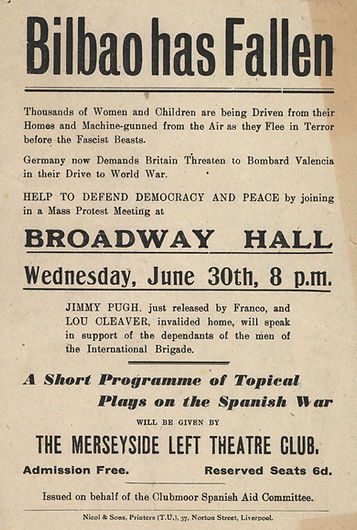
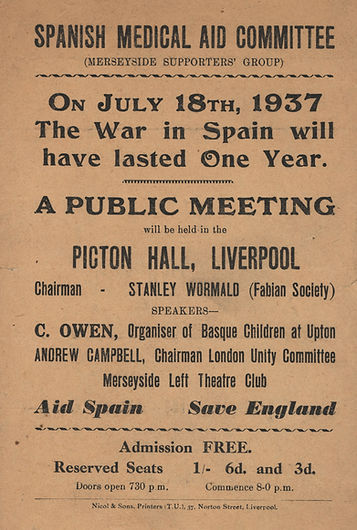


Letters to and from club member Renee Criddle and Left Book Club Theatre Guild organiser John Allen concerning performances of Spain and Before Guernica, 23 June and 27 July 1937


Affiliation booklet for the Unity Theatre Club Limited London, c late 1930s
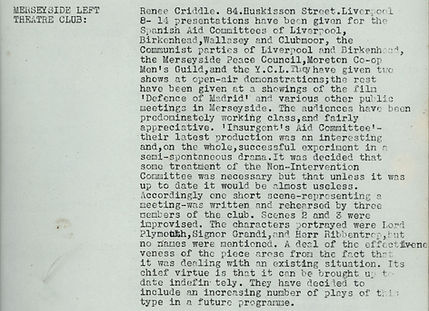
Extract from a Left Book Club Theatre Guild bulletin on the work of Merseyside Left Theatre Club including their original piece Insurgent’s Aid Committee written by Edgar Criddle, 1937

Early photographs of club members at social activities including rambles on the Wirral, c. late 1930s - early 1940s.

Early photographs of club members at social activities including rambles on the Wirral, c. late 1930s - early 1940s.

Early photographs of club members at social activities including rambles on the Wirral, c. late 1930s - early 1940s.
Early photographs of club members at social activities including rambles on the Wirral, c. late 1930s - early 1940s.

Seeking to further mobilise local people in the anti-war movement, the club introduced another programme of agit-prop plays including And so to War by Joe Corrie and Stop those War Drums by Irene Paull. The latter was a powerful mass declamation which included actors running from the audience onto the stage in response to questions from the cast with exclamations like “Raise your fists and shout to the warmakers…Stop!”. A beating drum rising in a crescendo in time with calls from both the audience and the stage to protest against war sent a clear message to spectators and a call for the government to take action. They performed this programme for Bootle Peace Week in October 1937, but controversy followed in the papers including accusations of self-interest through the promotion of left-wing ideas.


